
Solar Radiation & Meteorology Theoretical Information
Solar radiation is the primary energy source driving Earth’s climate, weather systems, and biological processes. This page provides clear, foundational explanations of solar radiation, atmospheric behavior, and the meteorological parameters measured by modern sensors.
Use the navigation to explore:
The Sun
The Sun supplies over 99.98% of the energy that reaches Earth’s surface. Its total output is approximately 3.72 × 10²⁰ MW, which corresponds to a radiative power of 63 MW per m² at its surface.
Solar Constant
At the average Earth–Sun distance (~150 million km), the intensity of radiation reaching the top of the atmosphere is:
1,367 W/m² — “The Solar Constant.”
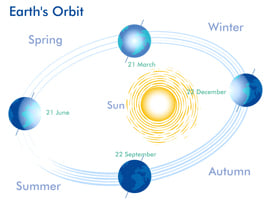
This value varies slightly throughout the year because Earth’s orbit is elliptical:
- Perihelion (closest): early January
- Aphelion (farthest): early July
- Radiation is ~7% stronger in January than July
This variation has only a minor influence on seasons.
The Atmosphere
Earth’s atmosphere (70–80 km thick) significantly modifies the radiation that reaches the ground.
Composition
- 78% Nitrogen
- 21% Oxygen
- ~1% other gases and water vapor — including greenhouse gases like CO₂ and CH₄
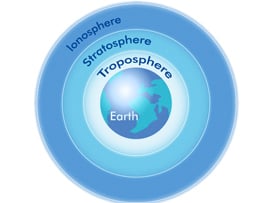 Atmospheric Layers
- Troposphere: weather, clouds, lowest 11–16 km
- Stratosphere: dry, houses the ozone layer
- Mesosphere: above ~50 km
- Thermosphere / Ionosphere: to ~640 km
- Exosphere: outer boundary
Half of atmospheric mass lies within the first 5–6 km of altitude.
How the Atmosphere Modifies Solar Radiation
Radiation is reduced by:
Scattering
- By clouds: across all wavelengths
- Rayleigh scattering: mainly short wavelengths (blue)
- Mie scattering: by aerosols, wavelength‑dependent
Absorption
- Ozone (UV)
- Water vapor (IR)
- Trace gases (SO₂, NO₂, aerosols)
Together, absorption and scattering change the spectral balance of radiation at the surface.
The Earth & Angle of Solar Incidence
The amount of solar radiation reaching Earth’s surface depends on:
- Earth’s curvature
- The thickness of atmosphere along the beam path
- Time of day and year
- Earth’s 23.5° axial tilt
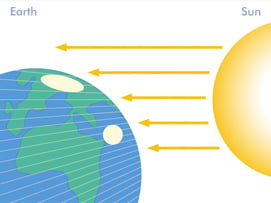
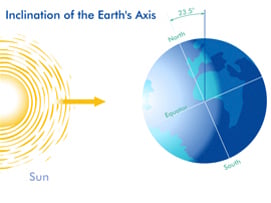
When the sun is high in the sky (solar zenith), radiation travels through less atmosphere and is most intense. Near the horizon, atmospheric path length is ~11 times greater, reducing radiation significantly.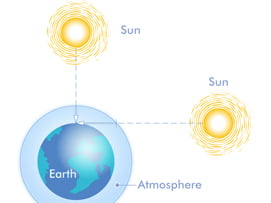
Albedo—the reflectivity of the surface—affects how much solar energy is absorbed or reflected.
Examples:
- Snow: high albedo
- Forests or dark rock: low albedo
Solar Radiation
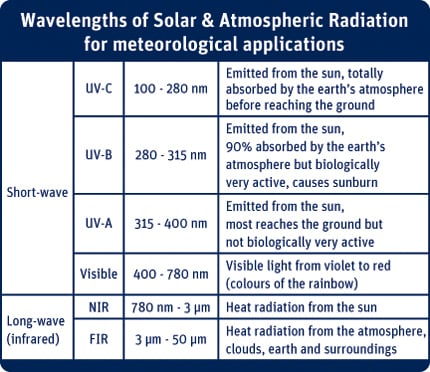
Solar radiation reaching Earth spans wavelengths from 300–3000 nm, the meteorologically significant range that includes:
- UV radiation
- Visible light
- Near and far infrared
Peak solar output occurs near 500 nm.
Spectral Behavior
- UV: scattered by molecules; absorbed by ozone/trace gases
- Visible: scattered by molecules and aerosols
- Infrared: absorbed mainly by water vapor
 Energy Balance at the Surface
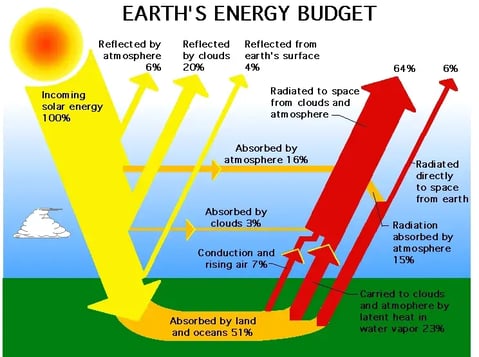
Of incoming extra‑terrestrial radiation:
- ~30% is reflected to space
- ~19% is absorbed in the atmosphere
- ~51% is absorbed by land and water
Absorbed short‑wave radiation becomes long‑wave infrared radiation, which is re‑emitted by Earth’s surface and atmosphere — a critical part of climate processes.
Meteorological Parameters
Meteorological observations provide essential data for weather forecasting, climate research, hydrology, air‑quality monitoring, and environmental modeling.
Main parameters include:
- Wind speed and direction
- Air temperature
- Air pressure
- Humidity
- Precipitation
- Visibility/haze
- Solar & terrestrial radiation
Short-Wave Radiation Components
- Direct Solar Radiation (S)
- Diffuse Sky Radiation (H)
- Global Radiation (G = S + H)
- Reflected Radiation (R)
- Albedo (R / G)
- Short‑wave Balance = (S + H − R)
Long-Wave Radiation Components
- Atmospheric Radiation (A)
- Ground Emission (E)
- Downward Global = S + H + A
- Upward Global = R + E
- Long‑wave Balance = A − E
Total Radiation Balance:
Q = S + H − R + A − E
Sensor Types
Pyrheliometer
Measures direct solar radiation, narrow field (<5°). Requires a sun tracker.
Pyranometer
Measures global or diffuse radiation, 180° field. Can be configured with glare shields or shading devices.
Pyrgeometer
Measures long‑wave infrared radiation.
Net Radiometer
Combines pyranometers and pyrgeometers to measure radiation balance.
UV Index & UV Radiometers
Although UV radiation is only ~6% of total solar energy, it has strong biological impacts.
The UV Index (UVI) is an internationally standardized measure indicating the intensity of erythemally weighted UV radiation at Earth’s surface.
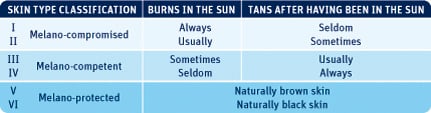
Skin Type Classification
Different skin types respond differently to UV exposure.
Kipp & Zonen UV‑S‑E‑T Radiometers
Designed for accurate measurement of erythemal UV radiation, these sensors include:
- Quartz domes and diffusers
- Cosine‑corrected response
- Thermostatic control for high accuracy
- Rugged construction for extreme environments
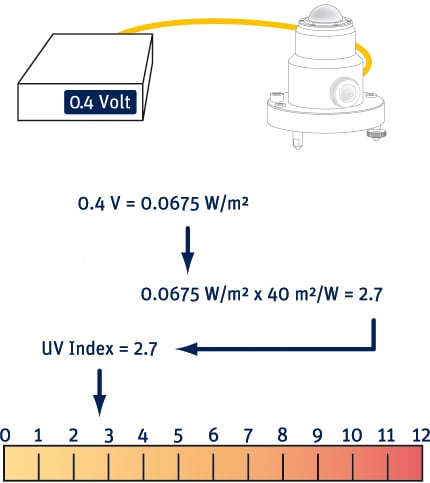
Output: 0–3 VDC corresponding to 0–0.6 W/m² of erythemal radiation.
UV Index Calculation
- Measure UV‑E radiation using a UV‑S‑E‑T sensor (ISO 17166 compliant).
- Convert sensor output voltage to W/m² using the instrument’s sensitivity.
- Apply UV Index formula (provide graphic or formula box).
The radiometer’s filter set matches the erythemal action spectrum, ensuring human‑skin‑relevant UV measurement.