
Calibration and repair services for performance and accuracy
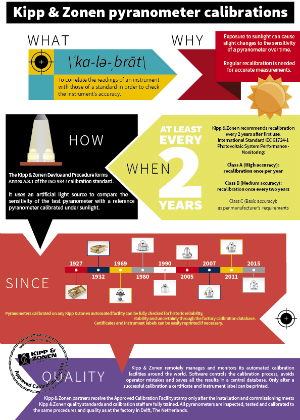
Regular calibration of all measurement equipment is the key to maintaining the original performance and accuracy. We recommend calibration of the sensitivity of our radiometers every two years.






Connect with our service team
Support that keeps your data flowing


.svg)

Calibration services
The individual sensitivity of a Kipp & Zonen radiometer is determined under the measurement conditions stated on its calibration certificate and is valid at the date of first use. If the radiometer is carefully stored in dark, warm and dry conditions and desiccant is changed as required, the sensitivity will not change.
Many factors affect the measurement uncertainty of a radiometer under varying measurement conditions that differ from the calibration conditions, but the non-reversible effect on sensitivity is mainly caused by exposure to solar radiation. The physical properties of any optical radiometer change due to ultraviolet (UV) radiation affecting diffusers, optical filters, photodiodes, and the black absorber coating of thermopile detectors.
Kipp & Zonen specifies this ageing affect as ‘non-stability (change/year)’ and, in general, it will take about 2 years to noticeably affect the accuracy of measurements. It is for this reason that Kipp & Zonen recommends you calibrate your radiometers at least once every two years.
However, industrial customers using our products in testing, quality or process control (including solar energy) may have internal QA/QC procedures that require annual calibration. Certain industry standards, such as IEC 61274-1, Ed 2.0, July 2021 Photovoltaic system performance – Part 1: Monitoring, may also specify a two-yearly calibration interval.
Repair Services
Kipp & Zonen products are designed for a long operating life and most components, other than consumables used in regular maintenance, do not have a specific life-time. However, components do degrade or require servicing to maintain optimal performance depending upon age, the operating conditions and maintenance.
It sometimes happens that products become damaged by accident or by extreme conditions (such as lightning strikes). In this case repairs and the replacement of parts will be necessary. Many service or repair activities can be carried out at our offices in France, Singapore and the USA. However, some operations require specialised equipment at the factory in the Netherlands. However, there is a limit to the repairs that can be carried out on very old instruments due to parts becoming unavailable. For more information contact us.
Dome and Window Damage
Scratches or chips on a dome or window might affect the radiometer readings; depending on the instrument and its application and the size, location, and number of scratches or chips.
For diffuse horizontal solar irradiance (DHI) measurements the pyranometer is shaded from the direct sun beam and most small scratches will not affect the readings significantly.
Reflected solar radiation is largely diffuse and small scratches will have little effect on the readings.
Global horizontal solar irradiance (GHI) and tilted global solar irradiance include the direct sun beam. Therefore, scratches or chips located on parts of the pyranometer dome over which direct sunlight passes during the day will affect the measurements. It may be possible to get around this by re-orienting the radiometer such that the damage is located in a position where it will only be exposed to diffuse radiation.
Note that radiometers measuring global ultraviolet radiation are more affected by scratches as the short wavelengths of light are more easily scattered. Far-infrared long-wave radiation from the atmosphere, or a surface, is less easily scattered and the radiation is largely diffuse and homogeneous, so pyrgeometers are less affected by scratches and chips. The silicon crystal pyrgeometer window, or dome, can only be replaced at the factory and recalibration is required. If the silicon has been cracked it is likely that the detector will also need replacement. For direct normal solar irradiance (DNI) measurements, damage to a pyrheliometer window will scatter the solar beam and the window must be replaced at the factory and the instrument must be recalibrated. If you send clear images of the dome or window damage to us we can advise whether replacement is necessary.
User Replacement of Domes
The outer dome of double-dome pyranometers and albedometers, and the dome of most UV radiometers, can be replaced by the user. The kits include new fixing screws and o-ring seals. Kipp & Zonen domes are made from specific materials to closely controlled dimensions, so changes in sensitivity will be small.
However, because of the level of measurement performance of which they are capable, it is advisable to recalibrate the CM22, CMP22 or SMP22 if the dome is changed.
Please note that the CM21 and 22, CMP21 and 22, SMP21 and 22 are supplied when new with the directional error test data. If the outer dome is replaced the directional response will change and, if you use the error data, a new factory test will be required.
Effects of Impacts and Damp
Accidental damage can also affect the sensitivity; a large impact, such as dropping the instrument, can permanently change the sensitivity or cause an open circuit connection internally. If desiccant is not changed when necessary, or parts of the housing are loosened, humidity will build up over time inside the instrument. When the ambient temperature drops to a minimum (usually just before dawn) the air inside the instrument may go through a dew point. In this case, water will first condense on the inside of the dome or window, this will cause large errors in the measurements. If condensation occurs on the optical filters, photodiodes, or the black absorber coating of thermopile detectors it can permanently change the sensitivity. Condensation on the electronics can cause corrosion and malfunctions. If damage or condensation has occurred, please contact us for advice.
To Ensure the Best Radiometer Performance
-
Keep the dome or window clean; free of dust and particles, dew, rain, frost, snow and scratches.
-
Change desiccant as required.
-
Don’t drop it, and calibrate regularly.
Frequently Asked Questions
Submit a service request and we will provide instructions for shipping and next steps.
SRA /RMA
Kipp & Zonen - Delft
When you submit this form, it will not automatically collect your details like name and email address unless you provide it yourself.
* Required
Section
This form applies to service requests at Kipp & Zonen - Delft.
Complete all required fields (1-18) for processing. If a field is not applicable, enter ‘NONE.
Use original factory packaging to prevent shipping damage, and verify the correct shipping address to avoid misdelivery.
By consenting to the listed prices, you authorize immediate processing, reducing service delays.